The Wins Were Hiding in the Losses
Power surge hit the RV park. 47 containers back in five minutes. The stack came back stronger.
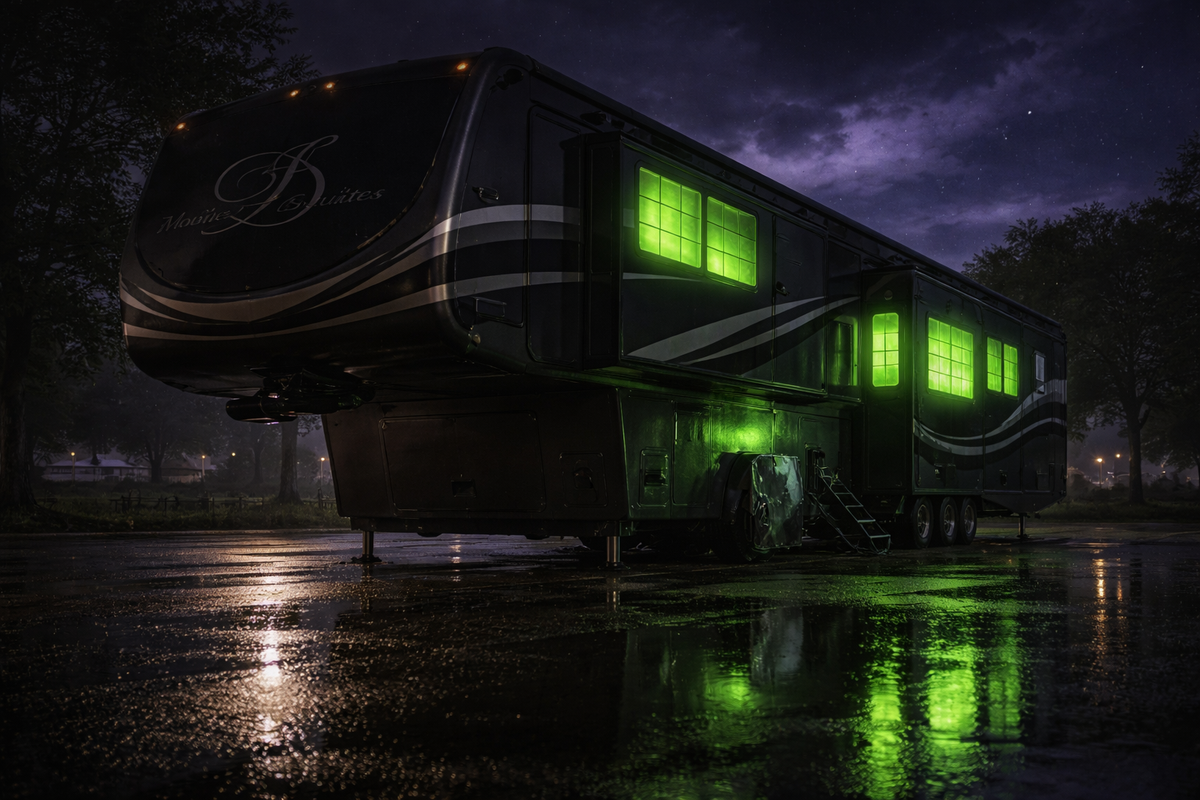
The power went out on a Tuesday night. Not the metaphorical kind where your cloud provider has an outage and you refresh a status page. The real kind. Where something pops, the UPS screams, and you are sitting in a 40ft fifth wheel wondering if you just lost everything you have been building for three weeks.
You did not. Not even close.
The Hit
March 31st, 2026. Power surge ripped through the RV park infrastructure hard enough to destroy the Hughes Autoformer sitting between shore power and my rig. Board 1... gone. The autoformer did exactly what it was designed to do. It absorbed the hit. It sacrificed a $50 circuit board so my fridge, my AC, my main circuitry and switches, a Dell Optiplex running 47 Docker containers, and a Proxmox host with a GPU-passthrough AI inference VM did not have to.
Both machines came through without a scratch.
Here is the part that matters. Forty-seven containers came back the moment the machine finished booting. Entered my encryption key, the OS loaded, Docker started, and the entire stack was live. Five minutes from power restored to green board. No manual intervention. No emergency SSH session. No frantic docker compose up. The restart policies, the compose architecture, the network segmentation... all of it worked exactly as designed. I built self-healing infrastructure hoping I would never need it. Then I needed it. And it worked.
I didn't rely on luck. This is my architecture.
What the Surge Shook Loose
Here is the thing about getting hit... it forces you to look at everything. Not just the thing that broke. Everything. And when you look at everything, you find things that were broken before the hit that you never knew about.
The Cloudflare tunnel that connects this site to the internet had been fighting a silent protocol war since it was deployed. It tried to use QUIC on every fresh start. The firewall silently blocked the UDP traffic. Cloudflared would retry... and retry... and retry... with exponential backoff... and never fall back to HTTP/2 on its own. One flag in the systemd config fixed it permanently. The tunnel has not dropped since.
That bug had been there for weeks. The surge forced the deep look that found it.
Same day, same momentum. Jellyfin pushed a security update. Four CVEs. Patched within hours of the release announcement. The hardening from Project Battleship... the cap_drop: ALL, the no-new-privileges, the resource limits... all survived the update intact. Not a single security control had to be rolled back to apply the patch.
"Every loss hides a lesson. Some of them hide wins. You just have to dig past the part where everything is on fire."
Meanwhile, the Paperwork
While the stack was proving it could take a punch, the business side was standing up too.
Sholmire Consulting LLC filed with the Oklahoma Secretary of State. EIN acquired. Business bank account in progress. Three weeks from "I should probably inventory my equipment" to an actual legal entity with tax identification. The LLC name disappears behind the work... nobody sees it except banks, the IRS, and contract counterparties. The brands people see... The Paranoid~R.V., the blog, the tools... those live on top.
The timing was not planned. You do not schedule your LLC filing to coincide with a power surge. But there is something poetic about the stack surviving its first real-world hit on the same week the business becomes real. One proved the infrastructure works. The other proved the builder is serious.
The Neural Pipeline
There is a persistent memory system that connects all of the AI workstations I use to build and manage this stack. It has been read-only for weeks... the AI crew could see everything about the system but could not write anything back without manual intervention.
That changed this week. The write pipeline is live. Session logs, action items, knowledge entries... all flowing through the system without me copying and pasting between windows. The AI does not just read the state of the ship anymore. It contributes to the record.
If that sounds like a small thing, imagine running a six-person team where nobody can take notes in the shared notebook. Every meeting summary, every decision, every lesson learned has to be hand-transcribed by one person after the fact. That was the bottleneck. Now it is not.
Green Board
As of right now... every service is running. Every container is healthy. The tunnel is stable. The firewall is restored to deny-default. The business has a legal entity and a tax ID. The persistent memory system reads and writes. Five people have subscribed to this newsletter, which means five people are watching a guy rebuild his professional life from a fifth wheel RV using AI governance and cold beer as primary tools.
The stack is objectively stronger now than it was before the surge hit.
That is the thing about resilience. It is not the absence of failure. It is what you look like on the other side of it. The autoformer metaphor is almost too clean... something designed from the factory to sacrifice itself so the important stuff survives. That is governance. That is architecture. That is what this whole project is about.
You build the thing. The thing gets hit. You find out if the thing you built was actually the thing you thought you were building.
It was.
P.S. — Yes, I am publishing an article called "The Wins Were Hiding in the Losses" on April 1st. No, this is not a bit. The autoformer really is dead. The stack really did come back in five minutes. The LLC really is filed. If anything, the fact that this sounds too good to be true on the one day of the year nobody believes anything is... kind of the whole brand at this point.